Whoever first said, “It’s turtles, all the way down,” was misheard.
What they actually said was, “It’s circles, all the way down.”
Screenwriters, sooner or later, probably end up reading “The Hero with a Thousand Faces,” by Joseph Campbell. The book argues that all myths follow one central story structure. Whether that’s true or not, is beside the point. A lot of great artists (George Lucas, Stanley Kubrick, George Miller) have read the text, and they’ve gone on to create world-changing art based on it.
Bach’s fugues are assigned ad nauseam to music majors. Not because they’ve got a beat and you can dance to them, which they don’t, but because studying them teaches you how to think compositionally. Students internalize the patterns, and then they implement those patterns or refute them, as they see fit.
The deeper meaning of Euler’s formula, $e^{ix} = \cos x + i \sin x$, is: it’s circles, all the way down.
Plot $\sin x$, with $x$ ranging from $-\pi$ to $\pi$, against its own derivative; what do you get? A circle. Against its own integral? A circle. What about the previous two questions, using $\cos x$ instead of $\sin x$? A circle. When you plot $\text{Re}(e^{ix})$ against $\text{Im}(e^{ix})$? Guess.
People who spend enough time staring into $e^{ix} = \cos x + i \sin x$ go off and create amazing works based on it. The formula isn’t the end product; it’s the enabling of understanding.
On one side, you’ve got $e^{ix}$, which you can differentiate or integrate however you please, and it will wait patiently and quietly while you deal with the other side of the room.
On the other side, you’ve got $\cos x$ and $i \sin x$, splitting between real and imaginary, converting between rectangular and polar representations of complex numbers.
Euler’s formula is your personal Rosetta stone. It lets you translate back and forth between exponentials and trigonometry, between spinning phasors and x-y coordinates, wherever and whenever you please.
And when you let that variable be $\omega t$ — angular frequency times time — now you can slice and dice any time-varying signal into amplitudes or magnitudes or frequencies or phases or any other cut that your recipes require.
You can convince yourself that $e^{ix} = \cos x + i \sin x$, by comparing the Taylor series of the three terms. Both sides of the equation fall apart into power series, and you can interleave the terms of $\cos x$ and $i \sin x$ like merging traffic, to get $e^{ix}$.
The deeper truth of Euler’s formula is in what you can build with this newfound understanding. Now you have basis functions, to lasso any data, dissect it, and reassemble it into whatever novel monster you might imagine.
Now, you can analyze the vibration of motors, design guitar pedals, or create a cell phone network. You can filter a power supply, compress a JPEG, or do X-ray crystallography.
Benjamin Peirce substituted $\pi$ for x, got all befuddled, and whined: “It is absolutely paradoxical; we cannot understand it, and we don’t know what it means, but we have proved it, and therefore we know it must be the truth.”
But Richard Feynman understood it, and got it right: “The most remarkable formula in mathematics: $e^{i \theta} = \cos \theta + i \sin \theta$. This is our jewel.”
Keith Devlin waxed all poetic: “Like a Shakespearean sonnet that captures the very essence of love, or a painting that brings out the beauty of the human form that is far more than just skin deep, Euler’s equation reaches down into the very depths of existence.”
The Zen ensō represents life in harmony. This circle is a sacred symbol in Zen Buddhism that represents the connection between all things. Zen monks may practice ensō drawing throughout their entire lives, over and over and over.
Zen masters draw circles, because the purpose of circles, is perfection through imperfection.
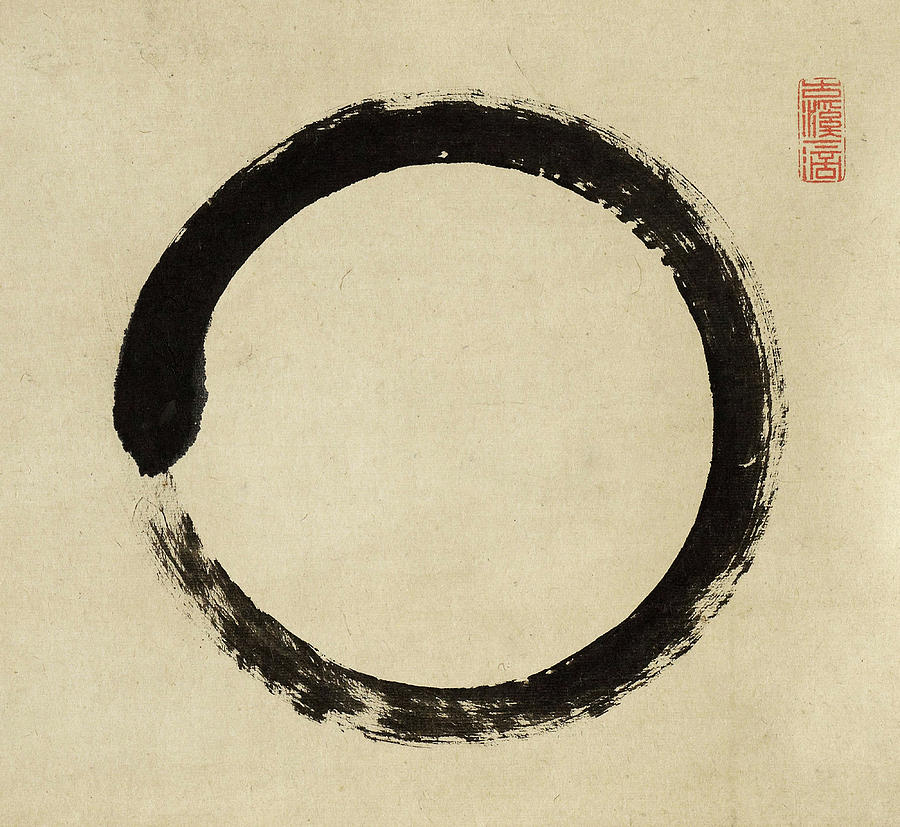
It’s circles, all the way down.
Once you’ve partied hard with Euler’s formula and built some fun stuff with it, you start looking around and thinking, well, what other basis functions are out there, that I can have some fun with?